Introducing
cmAngio®
Simple. Safe. Fast. Effective.
The next generation of AI-powered mammography analysis. FDA-cleared cmAngio® detects, quantifies, and contextualizes Breast Arterial Calcifications (BAC), providing radiologists with objective, clinical insights from routine mammograms.
Results in minutes. Read in seconds.
Objective BAC Extent Measurement
Age-Based Percentile & Prevalence
First and Only FDA Cleared Solution that Quantifies and Contextualizes
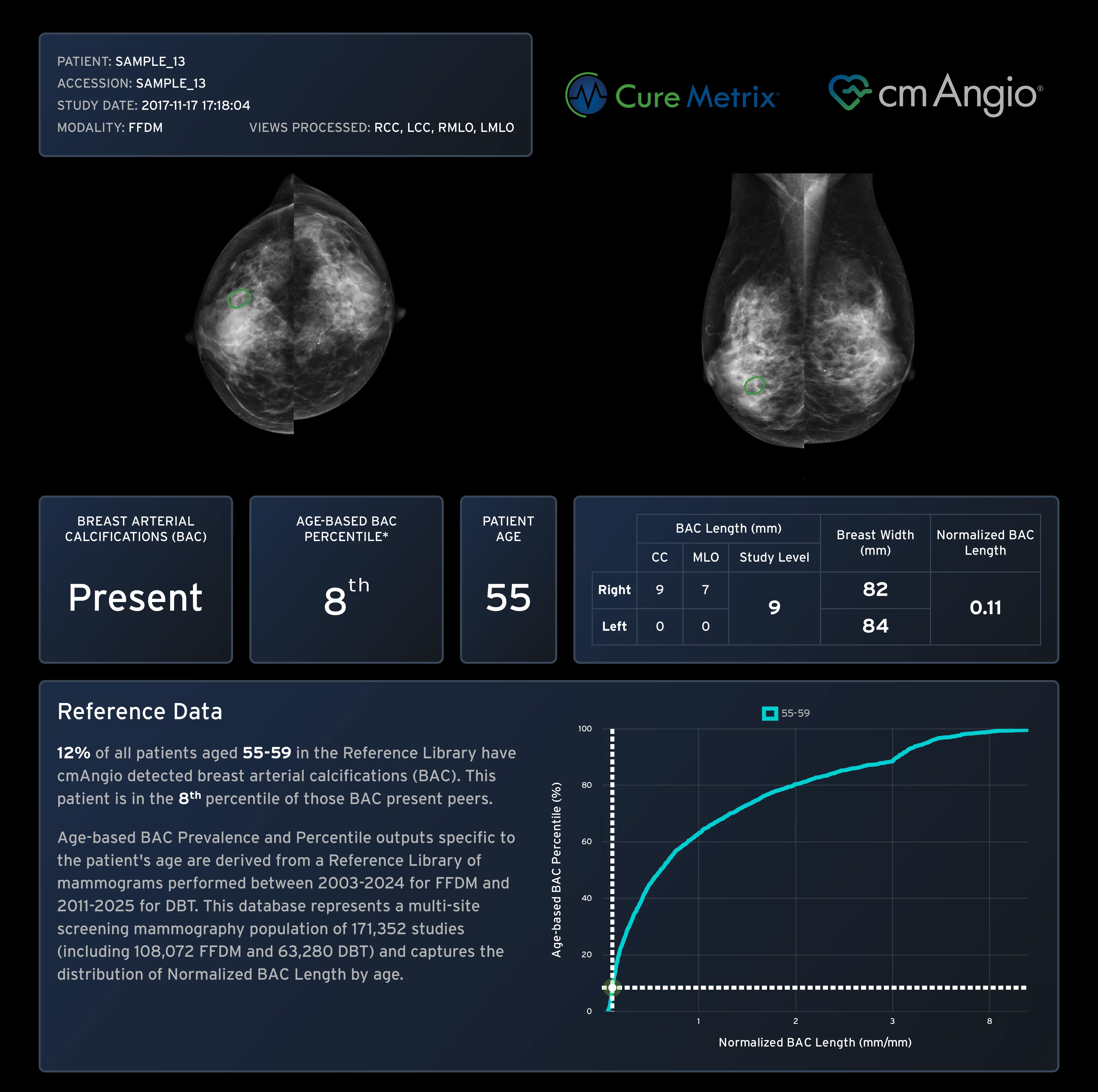
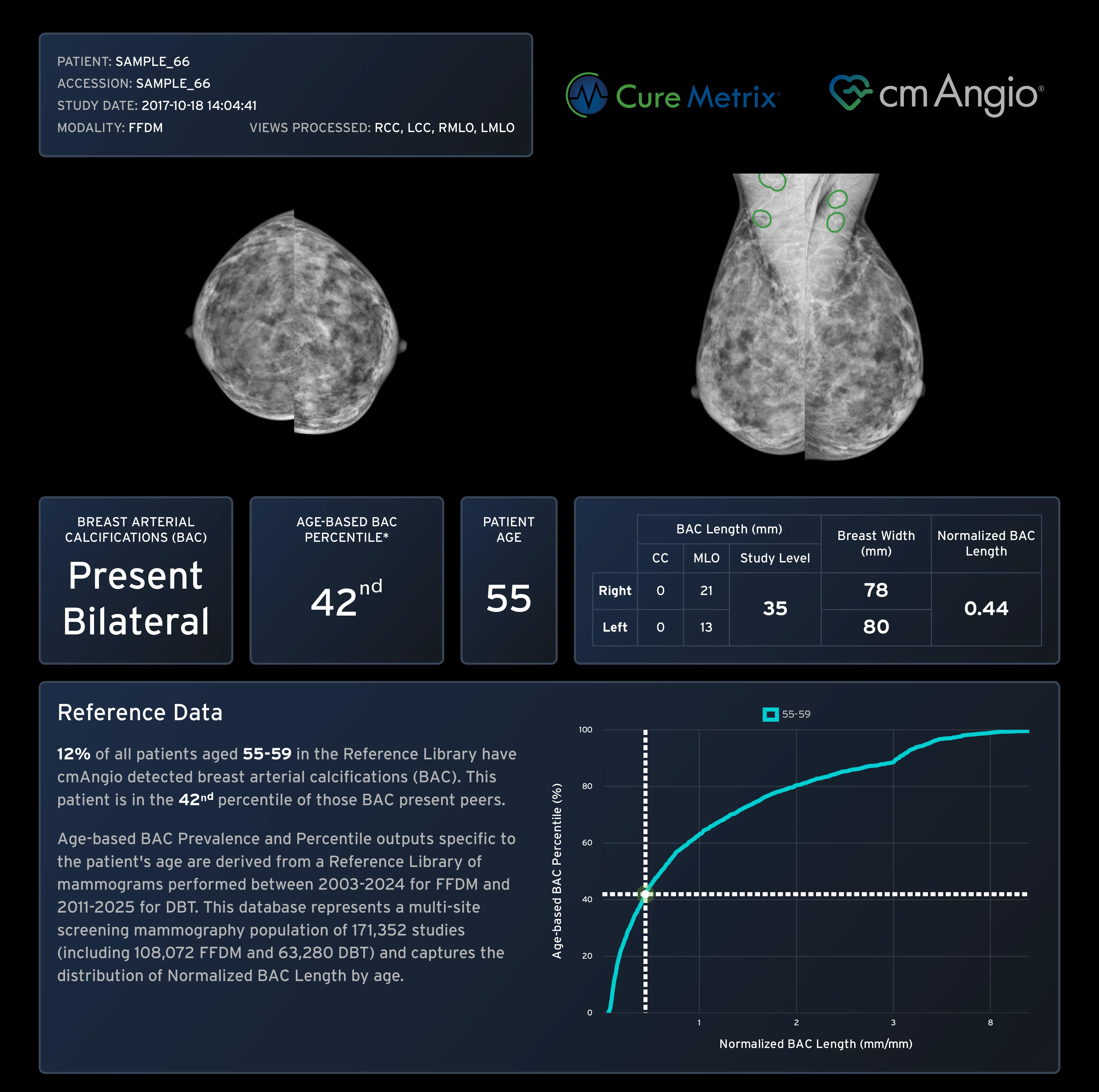
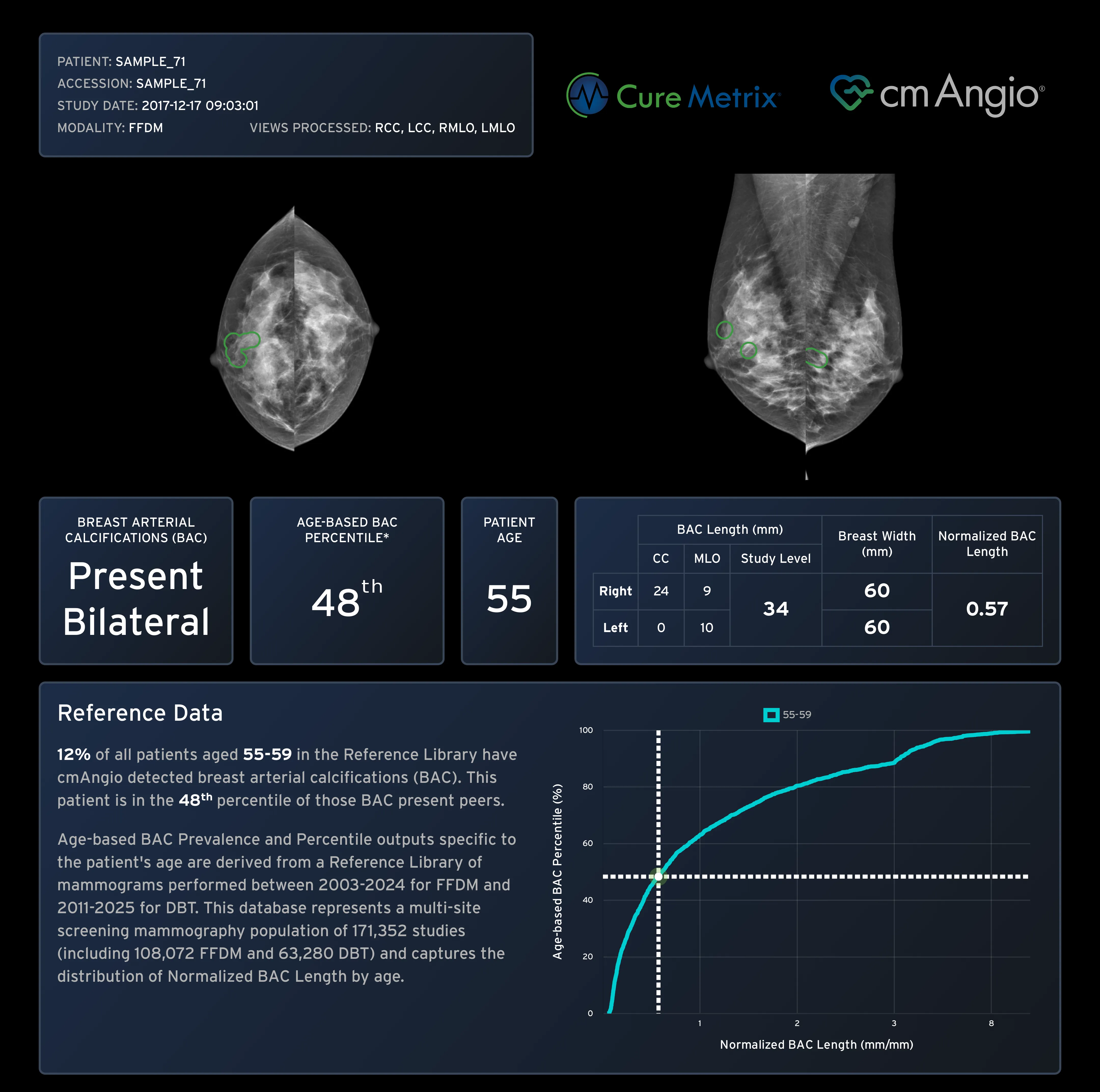
1 / 5
400+1
Live in over 400+ sites across the US
17%
Average BAC Present cases seen across all sites
0.98–0.992
AUC across DBT and FFDM cases
Transforming Mammography Into a 2-for-1 Exam
cmAngio detects, quantifies, and contextualizes Breast Arterial Calcifications on the same mammogram used for breast cancer screening — no new radiation, no new procedures. A woman already getting her mammogram can now also be screened for BAC and BAC extent.

12–25%3, 4
Of mammograms have breast arterial calcifications present
Yet less than 5% are actually reported. With an AUC of 0.98-0.99 across FFDM and DBT you can depend on the accuracy of cmAngio2.
See the EvidenceIndustry Momentum
The Growing Call to Report BAC
Maryland HB1364
Passed 2026 — Effective Oct 1, 2026Maryland became the first U.S. state to require patient notification of BAC findings from mammograms. Passed unanimously 136–0 in the House, the law requires screening result letters to include notice of arterial calcification.[5]
ACR BI-RADS® v2025 Manual
December 2025For the first time since 2013, ACR updated BI-RADS to acknowledge BAC as a clinically relevant incidental finding — a meaningful shift from prior editions where reporting was described as optional without acknowledgment of clinical relevance.[6]
ACR Quality Measure — MIPS QMM 28
2025 Performance YearCMS approved QMM 28, “Reporting Breast Arterial Calcification (BAC) on Screening Mammography,” as an ACR NRDR QCDR measure for the 2025 MIPS performance year, marking an important quality-program milestone for standardized BAC reporting.[7]
Northwell Health
Launched 2024 — Published July 2025Northwell Health implemented universal BAC reporting across mammography in 2024, identifying BAC in more than 11,800 patients during the first 10 months. Published patient survey data showed that 76% of respondents agreed all women should be informed about BAC findings on their mammogram.[8]
Canadian Society of Breast Imaging
2023 Position StatementCSBI issued the first major breast imaging society recommendation for universal BAC reporting on all screening mammograms, stating that BAC reporting “will provide an opportunity to improve awareness of women’s cardiovascular risk.”[9]
ACR Radiologist Survey
2022 — Academic RadiologyA survey of 598 ACR radiologist members found that 87% reported including BAC in mammogram reports at least some of the time, while only 41% reported doing so “always” or “most of the time.” The findings highlight variability in BAC reporting practices and an opportunity for greater standardization.[10]

A Clue Hiding in Plain Sight
“We have an incredible opportunity here to do two-for-one screening for two of the biggest threats to women's health and women's lives. There's really no argument that anybody can make to me for not doing it.”
— Dr. Nina Vincoff
Breast Radiologist, Prisma Health Executive Medical Director

Intelligent BAC Detection, Quantification, and Contextualization.
The future of screening mammograms is here.
References
- [1]Internal CureMetrix deployment data. Clinical site count and image validation figures reflect company operational metrics.
- [2]FDA 510(k) K260980 — cmAngio AI-based software for breast arterial calcification detection and localization. Performance data on file.
- [3]Loberant et al. "Prevalence and Degree of Breast Arterial Calcifications on Mammography: A Cross-sectional Analysis." Journal of Clinical Imaging Science, vol. 3, 27 Sep. 2013. doi:10.4103/2156-7514.11901
- [4]Iribarren et al. "Breast Arterial Calcification: Association with Diabetes Mellitus and Cardiovascular Risk." Journal of Women's Health, 2019.
- [5]Maryland HB1364, 2026 Regular Session — Public Health: Mammograms – Arterial Calcification Notice. Effective October 1, 2026. legiscan.com/MD/bill/HB1364/2026
- [6]American College of Radiology. BI-RADS v2025 Manual — Mammography Chapter. Reston, VA: ACR; 2025. (BI-RADS v2025, p. 51)
- [7]ACR NRDR. 2025 QCDR Measure Specifications — QMM 28: Reporting Breast Arterial Calcification (BAC) on Screening Mammography. American College of Radiology, January 2025. acr.org/News-and-Publications/2025-MIPS-Reporting-Includes-Five-New-ACR-QCDR-Measures
- [8]Parikh NI, Cacciabaudo JM, Singh VP, Vincoff NS. Giving Women What They Want: Reporting Breast Arterial Calcification on Mammograms at Northwell Health System. JACC Adv. 2025 Jul;4(7):101914. doi:10.1016/j.jacadv.2025.101914
- [9]Canadian Society of Breast Imaging. Position Statement: Breast Arterial Calcification (BAC) Reporting on Mammography. 2023.
- [10]Brown AL, Wahab RA, Zhang B, Smetherman DH, Mahoney MC. Reporting and perceptions of breast arterial calcification on mammography: a survey of ACR radiologists. Acad Radiol. 2022;29(Suppl 1):S192–S198. doi:10.1016/j.acra.2021.01.027