
Bringing Vascular Health into Focus
One Mammogram at a Time
cmAngio® is an ANVISA registered medical device using Artificial Intelligence (AI) to detect Breast Arterial Calcifications (BAC), an incidental finding in routine screening mammograms, indicative of arteriosclerosis.
BAC are calcifications in the breast arteries that can indicate arteriosclerosis, a type of arterial stiffening that can be attributable to cardio-vascular disease. cmAngio analyzes both full-field digital mammography (FFDM) and digital breast tomosynthesis (DBT) screening mammograms to identify and mark these anomalies, which are currently only identified as incidental findings.
Importantly, cmAngio allows radiologists to use existing screening mammograms to identify women who have BAC and, when appropriate, refer them for further evaluation tied to important health outcomes without any additional radiation or procedure. It highlights the BAC directly on the image so radiologists can easily review and report.
The call to action is clear: by integrating BAC detection and localization into routine imaging, we can address one of the most pressing, under-recognized risks in women's health.
Understanding Breast Arterial Calcifications
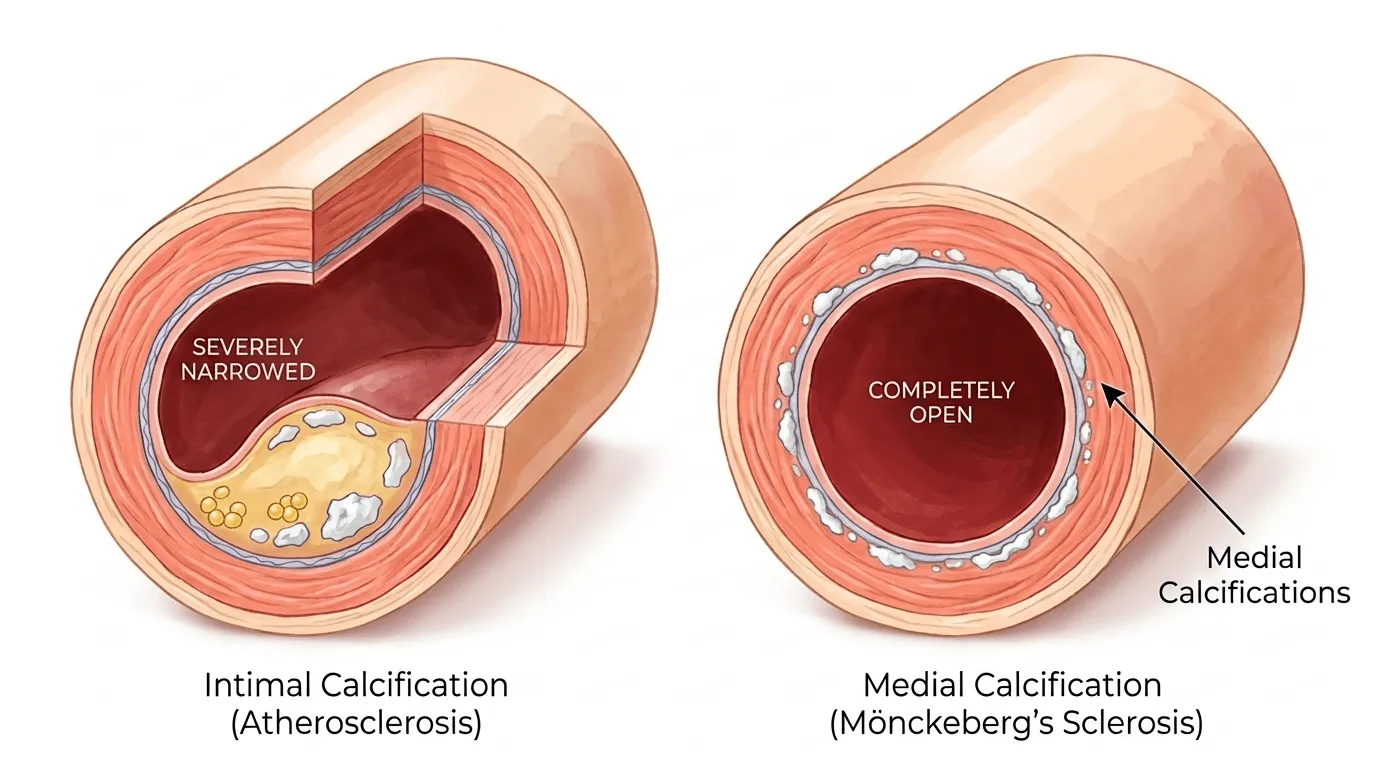
Breast Arterial Calcifications (BAC) are deposits that form within the medial layer of breast arterial walls — a pattern of vascular mineralization known as Mönckeberg's arteriosclerosis. Unlike intimal calcifications of atherosclerosis, which narrow the arterial lumen and restrict blood flow, BAC preserve luminal patency. Yet their presence signals something clinically important: systemic vascular disease.
BAC are detected in 12–25% of women undergoing screening mammography, yet fewer than 5% of cases are formally reported1 — leaving a significant cardiovascular risk signal unacknowledged.
Research increasingly links BAC to major adverse cardiovascular events (MACE), including heart attack, stroke, heart failure, and cardiovascular mortality. BAC have also been independently associated with chronic kidney disease (CKD), type 2 diabetes, hypertension, and peripheral arterial disease — conditions that share the same underlying biology of medial vascular calcification.
Heart disease is the #1 killer of women.
Most never see it coming.
Nearly 80%4 of cardiovascular disease is preventable. Yet the majority of women aren't screened to identify potential risks — such as the presence of breast arterial calcifications.
CureMetrix changes this through contextualized precision screenings.
Heart disease diagnosis imbalance in women
Women who die from heart disease and are asymptomatic or have symptoms that are missed2
More women die from Heart Disease than from Breast Cancer3
Of breast arterial calcifications reported by radiologists6
Breast Arterial Calcifications impact women's health
Increase in risk of heart disease or stroke5
Increase in cardiovascular event-specific death5
Women aged 60-79 have arterial calcification6
cmAngio Key Features
Built for clinical workflows with flexibility, security, and ease of integration.
Adjustable Operating Point
Adjustable operating point to meet clinical goals and workflow preferences.
FFDM & DBT Processing
Processes both Full Field Digital Mammography (FFDM) and Digital Breast Tomosynthesis (DBT) For Presentation exams from GE and Hologic.
Easy Integration
cmAngio easily ties into existing radiology tools and clinical workflow.
Automated Processing
BAC segments are localized, marked and displayed on scorecard for review.
Batch Read Ready
Results are returned in minutes and can be read in seconds. Cleared on screening mammograms for women aged 40-90.
All Densities
Demonstrated performance across all breast densities.
BAC Detection and Localization Starts Here
See how cmAngio can unlock BAC insights from existing mammography workflows, empowering care teams with actionable detection data.
Schedule a DemoSources
- 1Loberant, Norman et al. "Prevalence and Degree of Breast Arterial Calcifications on Mammography: A Cross-sectional Analysis." Journal of Clinical Imaging Science, vol. 3, 27 Sep. 2013. doi:10.4103/2156-7514.11901
- 2CDC — Women and Heart Disease. www.cdc.gov/heart-disease/about/women-and-heart-disease.html
- 3Go Red for Women / American Heart Association — Facts. www.goredforwomen.org/en/about-heart-disease-in-women/facts
- 4World Health Organization / JAMA Network Open — CVD Prevention Insights. Targeted Oncology
- 5Nerlekar N et al. "Automated Breast Arterial Calcification Score Is Associated With Cardiovascular Outcomes and Mortality." JACC: Advances. 2024;3(11):101283. doi:10.1016/j.jacadv.2024.101283
- 6Allen TS, Bui QM, et al. "Automated Breast Arterial Calcification Score Is Associated With Cardiovascular Outcomes and Mortality." JACC: Advances. 2024;3(11):101283. doi:10.1016/j.jacadv.2024.101283
Disclaimer: cmAngio is FDA-cleared for commercial use for BAC detection and localization. Content and publications on this page have not been cleared by the FDA.
ANVISA
Registered in Brazil
MDSAP
Certified
ISO 13485
Certified
Global regulatory in progress. Cleared in Brazil. Targets: Canada, Australia, EU, and other key markets.