The Crisis Hiding in Plain Sight
Cardiovascular disease claims more women's lives than all cancers combined.
Most never see it coming.
7× more women die of heart disease than breast cancer1. Every 34 seconds, another life is lost to CVD2. Yet 44% of women don't even know it's their greatest threat3.
Nearly 80% of these deaths are preventable4. Yet the majority of women aren't screened to identify potential risks — such as the presence of breast arterial calcifications.
CureMetrix is working to change this through our research and development efforts with our many KOL and clinical collaborators.

Understanding Breast Arterial Calcifications
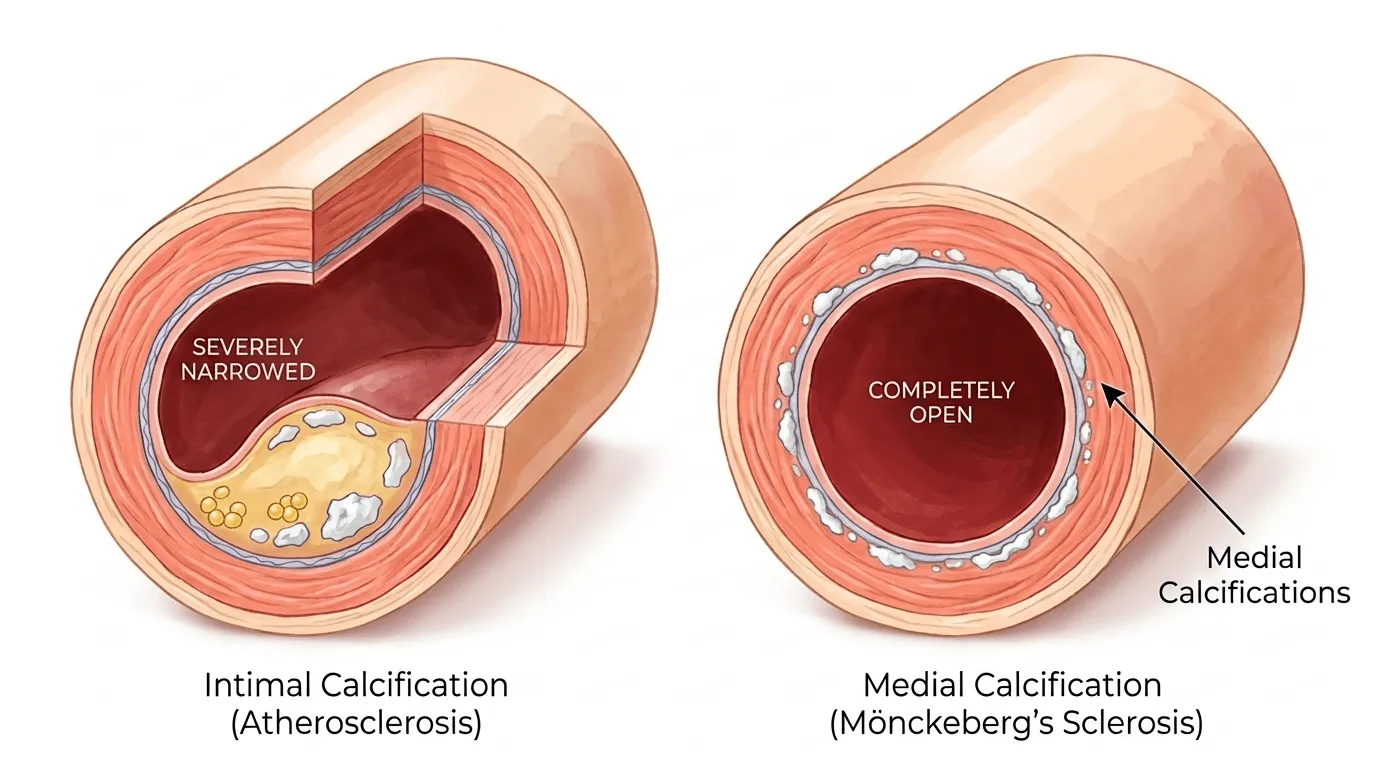
Breast Arterial Calcifications (BAC) are deposits that form within the medial layer of breast arterial walls — a pattern of vascular mineralization known as Mönckeberg's arteriosclerosis. Unlike intimal calcifications of atherosclerosis, which narrow the arterial lumen and restrict blood flow, BAC preserve luminal patency. Yet their presence signals something clinically important: systemic vascular disease.
BAC are detected in 12–25% of women undergoing screening mammography, yet fewer than 5% of cases are formally reported6 — leaving a significant cardiovascular risk signal unacknowledged.
Research increasingly links BAC to major adverse cardiovascular events (MACE), including heart attack, stroke, heart failure, and cardiovascular mortality. BAC have also been independently associated with chronic kidney disease (CKD), type 2 diabetes, hypertension, and peripheral arterial disease — conditions that share the same underlying biology of medial vascular calcification.
Clinical Research — JACC: Advances, 2024
BAC on mammograms independently predicts cardiovascular risk
A landmark study of 18,092 women7 at UC San Diego found that breast arterial calcification (BAC) — already visible on routine screening mammograms — independently predicts heart attack, heart failure, stroke, and all-cause mortality, even after controlling for every major cardiovascular risk factor. BAC was quantified using cmAngio, an AI-powered algorithm that scored each mammogram with 94% sensitivity and 96% specificity, enabling the first large-scale outcomes study of its kind. No additional imaging. No additional cost.
Controlled for all major risk factors
BAC remained independently significant across all outcomes
Study findings at a glance
18,092
Women studied — the largest outcomes study using AI-quantified BAC scores from routine screening mammograms
+56%
Adjusted increase in composite cardiovascular risk (MI, heart failure, stroke & mortality) with BAC present
40–59
Age group with the strongest residual risk — BAC as an early biomarker before traditional risk factors emerge
Outcomes — women with BAC vs. without BAC
Mortality
3×
With BAC: 7.8%
Without BAC: 2.3%
Median 4.8-year follow-up
Heart failure
3.7×
With BAC: 3.7%
Without BAC: 1.0%
Median 3.0-year follow-up
Stroke
2.5×
With BAC: 2.7%
Without BAC: 1.1%
Median 3.0-year follow-up
Myocardial infarction
3×
With BAC: 0.9%
Without BAC: 0.3%
Median 3.3-year follow-up
Get Involved
Participate in Ground Truth / Reader Study
Help shape the future of AI-powered cardiovascular risk detection by contributing your expertise and data.
Ground Truth / Reader Study
Participating in a ground truth study with CureMetrix provides radiologists with the opportunity to play a crucial role in developing cutting-edge AI technology for breast cancer and heart disease diagnosis and treatment. By reviewing images and providing feedback, radiologists can help train our software to be more accurate and reliable.
CureMetrix offers compensation to radiologists who participate, providing an opportunity to earn money while contributing to the development of AI-powered medical imaging solutions.
Share Your Data
By sharing your data with CureMetrix, you can help us to develop and improve our AI-powered solutions, ultimately leading to better patient care and outcomes.
We understand that your patient data is sensitive and valuable, which is why we take the utmost care to ensure the privacy and security of your data. Our solutions are designed to comply with all relevant data privacy regulations, including HIPAA, and we use state-of-the-art cyber security protocols to protect your data at all times.
Participate Under an IRB Protocol
Are you passionate about advancing the field of radiology and improving patient care? If so, joining an Institutional Review Board (IRB) approved study sponsored by CureMetrix could be the perfect opportunity for you.
IRB-approved studies ensure the highest ethical standards in research, protecting participant rights while driving meaningful clinical insights. Our IRB protocols are designed to evaluate the real-world performance and clinical utility of cmAngio and the CARMA Score across diverse patient populations.
Clinical Evidence / Publications
Filter by product to see the studies relevant to your clinical needs.
A Novel Breast Arterial Calcification Age-Based Percentile Nomogram for the Incremental Prediction of Incidental Cardiovascular Events
JACC: Cardiovascular Imaging
Automated Breast Arterial Calcification Score Is Associated With Cardiovascular Outcomes and Mortality
JACC Advances
Breast Arterial Calcifications on Mammography: A Survey of Practicing Radiologists
Journal of Breast Imaging
Association of Breast Arterial Calcification With Coronary Artery Calcification in Younger versus Older Women
AHA Journals (Circulation)
Breast Arterial Calcifications in the News
BAC detection and localization on routine mammography is gaining worldwide attention across media, clinical societies, and leading health institutions.
Media Coverage
New mammogram policy: Maryland to require BAC notifications with first law of its kind
Can a mammogram help identify heart disease?
What your mammogram can tell you about your cardiovascular health
Routine mammograms may help predict heart disease, study suggests
Calcium in breast arteries predicts future cardiovascular disease
Clinical Society & Institutional Announcements
Breast Arterial Calcification Could Be Warning Sign of Heart Disease
Mammograms may help predict heart disease, stroke risk in women after menopause
Canadian Society of Breast Imaging Position Statement on Breast Arterial Calcification Reporting on Mammography
High-Impact Clinical/Research Publications
Automated Breast Arterial Calcification Score Is Associated With Cardiovascular Outcomes and Mortality — Allen, Bui et al. (cmAngio/UC San Diego study)
Giving Women What They Want: Reporting BAC on Mammograms — Northwell Health System
BAC as a Cardiovascular Risk Factor: Time to "Bust" It Out
Novel AI-Based Quantification of BAC to Predict Cardiovascular Risk — Emory/Mayo Clinic, 116,135 women
BAC on a Screening Mammogram: A Potential CVD Risk Stratification Tool in Women

Transforming Women's Health
“cmAngio's ability to detect breast arterial calcifications from existing mammograms opens an entirely new pathway for identifying patients who may benefit from further evaluation. It's a game-changer for women's health.”
— Dr. Tiffany Di Pietro MD, DO, FACC, FACOI
Cardiologist & Medical Advisor, Cardiology of Ft. Lauderdale
Sources
- 1 CDC — Women and Heart Disease www.cdc.gov/heart-disease/about/women-and-heart-disease.html
- 2 CDC — Heart Disease Facts & Stats www.cdc.gov/heart-disease/data-research/facts-stats/index.html
- 3 Go Red for Women / American Heart Association — Facts www.goredforwomen.org/en/about-heart-disease-in-women/facts
- 4 World Health Organization / JAMA Network Open — CVD Prevention Targeted Oncology
- 5 Nerlekar N et al. "Automated Breast Arterial Calcification Score Is Associated With Cardiovascular Outcomes and Mortality." JACC: Advances. 2024;3(11):101283. doi:10.1016/j.jacadv.2024.101283
- 6 Loberant et al. "Prevalence and Degree of Breast Arterial Calcifications on Mammography: A Cross-sectional Analysis." Journal of Clinical Imaging Science, vol. 3, 27 Sep. 2013. doi:10.4103/2156-7514.11901
- 7 Allen TS, Bui QM, et al. "Automated Breast Arterial Calcification Score Is Associated With Cardiovascular Outcomes and Mortality." JACC: Advances. 2024;3(11):101283. doi:10.1016/j.jacadv.2024.101283
Disclaimer: cmAngio is FDA-cleared and ANVISA notified for commercial use for BAC detection and localization. The version utilized in the research studies, which generate the Bradley Score, is for research use only and is not currently available for commercial distribution. Each publication should be reviewed in its entirety to understand the study methods, results, and limitations.
cmTriage and cmAssist are cleared for commercial use for FFDM only.
cmDensity is under development and is not available for commercial use in any country.